

A company with the characteristics of Infinity is subject to business risks, as is any other company. The main identified risks include (non-exclusive list): Exchange Rate, Logistics, Pricing, Quality, Regulatory, Default (Non-Payment), Import, Export, Competition, Margins, Seasonality, Transport, Documentation, Contracts, Licensing, Tax, Fiscal, Prices, Demand, Compliance, ESG, Reputation, Certifications, Climate, Jurisdiction, Credit, Inventory, Ports, Tariff, Insurance, Strikes, Fraud, Suppliers, Health/Sanitation, and Monitoring.
It is important to note that risks exist and must be known so that they can be managed. There is no such thing as zero risk; the company needs to know them and define or improve its ability to manage them.
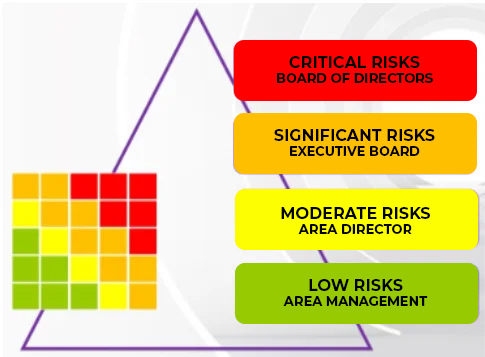
IST is fully aware of these risks and is seeking to implement good risk management practices, aiming in a second step to define the relevance of each risk (define a Heat Map, as shown in the figure), implement a risk culture, and utilize an internationally recognized methodology (such as COSO – Committee of Sponsoring Organizations of the Treadway Commission), aiming to define more effective measures applied to the company’s reality to mitigate those considered critical.
The preliminary work conducted with the support of an expert marks the beginning of this risk management journey, which must now be implemented in an organized and gradual manner, observing budget and investment guidelines.
The following risks were identified in this preliminary phase, considering the classification into Strategic, Financial, Operational, Regulatory, and Cyber:

1. Dependence on niches and large clients:
Concentration on specific clients and regions may expose the company to risks of revenue decline.
2. Competition in the seafood sector:
Presence of national and international players with access to greater capital and logistical scale.
3. Reputation and brand:
Any quality or food safety issue can directly impact customer trust.
4. Cash flow (Working capital):
Mismatch between payments and receipts (working capital), necessary for financing inventory and longer collection periods.
5. Foreign exchange exposure:
A portion of imported inputs and products may be subject to foreign exchange variations and international tariffs.
6. Margins:
Fluctuation in seafood prices and logistical costs recurrently compress margins.
7. Integrity:
Execution of operations not in accordance with usual practices and company guidelines, resulting in financial losses.
8. Logistics:
Breaks in the receiving chain and/or logistical failures compromise product quality and safety.
9. Supplier dependence:
Dependence on international suppliers and risks of supply disruption.
10. Inventory management:
Risks of losses due to perishability or poor storage management.
11. Sanitary compliance:
Strict sanitary surveillance rules can lead to shutdowns in case of non-compliance.
12. Taxation:
Brazilian tax complexity directly impacts costs and tax compliance.
13. Licensing and exports:
The need for adequate documentation and licenses can generate risks of delays and fines.
14. Information security:
Risk of leakage of sensitive customer data, supplier data, and financial controls.
15. Ransomware attacks:
Paralysis of critical systems for logistics, billing, and supply chain.
16. Digital fraud:
Possibility of electronic fraud in payments and commercial transactions.